Why This Page Exists
Large‑scale changes are underway in how electricity is generated and supplied across Western Australia, as the State transitions its energy system over coming decades. Regional areas, including the Shire of Victoria Plains, are increasingly part of this transition.
This page has been created to provide clear, factual and balanced information about the energy transition and what it may mean for our community.
Community members, landowners and businesses have told us they want:
- reliable information in one place
- clarity about who makes decisions and how
- a better understanding of potential impacts as well as opportunities
This page responds to that need.
The Shire’s Role
The Shire of Victoria Plains is not a project proponent and does not approve large‑scale energy developments.
Decisions about major renewable energy projects are primarily made by State Government agencies, under State legislation and planning processes.
The Shire’s role is to:
- represent local interests
- provide input into planning and consultation processes
- help the community understand what is happening and how to participate
- advocate for fair, appropriate outcomes for Victoria Plains
This includes engaging with proponents, State agencies and the community to ensure local knowledge, risks and priorities are understood and considered.
Acknowledging Different Views
The energy transition raises strong and differing views within the community.
Some people see opportunities in investment, jobs and infrastructure. Others have concerns about impacts on landscape, amenity, land use, safety or long‑term outcomes.
The Shire recognises and respects this diversity of views.
This page is not intended to persuade or promote, but to:
- share credible information
- explain processes and responsibilities
- help people make informed decisions and submissions
Where possible, information is drawn from government, research and industry bodies, with links provided so readers can explore further.
How To Use This Page
Not everyone will need the same information.
You can use the sections below to go directly to topics most relevant to you, including:
- information for landowners
- information for neighbours and the wider community
- planning and approvals processes
- frequently asked questions
This page will be updated as new information becomes available.
Quick Links
What the Energy Transition Means
Across Western Australia, the way electricity is generated and supplied is changing.
Historically, most electricity came from large coal and gas power stations located away from where people live. That power was transported long distances through transmission lines to homes, farms and businesses.
Over time, this system is shifting towards a mix of energy sources, including wind, solar and large‑scale batteries, supported by upgrades to the electricity network. This shift is commonly referred to as the energy transition.
The transition is being driven by State and national energy policy, changing technology, and the need to maintain a reliable electricity system as older power stations are phased out.
How electricity is changing in WA
In Western Australia:
-
wind and solar are increasingly used to generate electricity
-
large batteries help store energy and support reliability
-
new and upgraded transmission lines are required to move electricity from where it is generated to where it is needed
Wind energy, in particular, plays an important role because it can generate electricity day and night when conditions allow, complementing solar generation which only occurs during daylight hours.
Because wind and solar generation varies depending on weather conditions, they must be supported by other technologies and careful system planning to ensure power remains reliable and secure.
Why regional areas are involved
Large‑scale renewable energy projects require:
- access to strong and consistent wind or sunlight
- large areas of land
- connection to the electricity network
These conditions are more commonly found in regional areas, which is why many proposed wind, solar and battery projects are located outside metropolitan centres.
Regional Western Australia has been identified as an important part of the State’s future electricity system, particularly as electricity demand is expected to grow over coming decades.
What this does not mean
The energy transition does not mean:
- every area will host energy infrastructure
- all proposed projects will be approved
- decisions are made by local government alone
Each proposal is assessed through formal planning, environmental and regulatory processes, primarily at a State level, and many projects do not proceed beyond early investigation stages.
What this means for the Shire of Victoria Plains
Like many regional areas in Western Australia, the Shire of Victoria Plains is experiencing increased interest from energy developers as part of the State’s broader energy transition.
This interest is driven by regional characteristics, not by decisions made locally.
Why Victoria Plains may attract proposals
Large‑scale renewable energy projects tend to be proposed in areas that have:
- strong and consistent natural resources (such as wind)
- large areas of land suitable for development
- access to, or potential connection with, electricity transmission infrastructure
These factors mean some parts of regional WA are more likely to be investigated by proponents than metropolitan areas.
Being identified as suitable for investigation does not mean a project will proceed.
What types of developments may be proposed
Across regional Western Australia, energy proposals may include:
- wind farms
- solar farms
- large‑scale batteries
- transmission infrastructure to connect projects to the grid
Proposals typically progress through multiple stages, including early feasibility studies, environmental and technical assessments, and formal planning and approvals processes. Many proposals do not advance beyond early investigation stages.
What the Shire does, and does not, control
It is important to understand the limits of local government decision‑making.
The Shire of Victoria Plains:
- does not approve large‑scale renewable energy projects
- does not decide whether projects proceed
- does not negotiate commercial arrangements on behalf of landowners
These decisions are primarily made by State Government agencies under State legislation.
The Shire’s role is to:
- provide local knowledge into planning and consultation processes
- represent community interests and concerns
- engage with proponents and State agencies
- advocate for fair, appropriate outcomes for the local area
What this means for the community
The presence of proposed energy developments can raise questions and concerns about:
- land use and amenity
- visual and landscape impacts
- noise, safety and environmental considerations
- long‑term outcomes for the community
It can also prompt discussion about potential benefits, including infrastructure improvements and local economic activity.
This page does not assume a single viewpoint. Instead, it aims to ensure community members have access to clear information so they can understand proposals, participate in consultation processes, and make informed submissions if they choose.
Information for landowners
Some landowners may be approached by energy developers to discuss potential projects on their land.
This section provides general information to help landowners understand the process and identify where independent advice may be useful.
Being approached by a developer
Early contact from a proponent may involve:
- requests for access to land
- preliminary studies (such as wind monitoring)
- discussions about potential hosting arrangements
Landowners are under no obligation to agree to access or negotiations.
Independent information
Agreements and negotiations
Hosting agreements can be complex and long‑term.
Landowners are strongly encouraged to:
- seek independent legal advice
- seek independent financial and valuation advice
- fully understand decommissioning and rehabilitation obligations
The Shire does not provide advice on contracts or commercial terms.
End‑of‑life and decommissioning
All large‑scale energy infrastructure has a defined operational life.
It is important for landowners to understand:
- who is responsible for decommissioning
- how land is rehabilitated
- what protections exist if ownership of a project changes
Links to independent, third‑party resources are provided below.
Information for neighbours and the wider community
People living near proposed energy developments often have questions and concerns about potential impacts.
This section provides general information commonly requested by community members.
How wind energy works
Wind turbines convert the movement of wind into electricity, which is then transmitted through the electricity network to where it is needed. Wind generation varies depending on weather conditions and is supported by other technologies to maintain reliability.
Learn more
Noise, health and safety
Noise and health impacts are frequently raised concerns.
In Australia, wind farms are required to comply with:
- strict noise standards
- setback and safety requirements
- environmental and planning conditions
Independent national and international health reviews have found no consistent evidence of direct adverse health effects from compliant wind farms.
Independent information
Bushfire and emergency management
Bushfire risk is considered during planning and assessment processes.
Requirements may include:
- emergency management planning
- access for emergency services
- operational procedures during fire events
Local fire and emergency services are typically consulted as part of these processes.
Visual and landscape impacts
Visual impacts can vary depending on location, terrain and individual perspective.
Planning and environmental assessments typically include:
- visual modelling
- landscape impact assessments
- consideration of nearby residences and viewpoints
These materials are made available during formal consultation periods.
Community benefits and impacts
Large‑scale energy projects can bring both impacts and potential benefits to host regions.
What community benefits are
Community benefits may include:
- financial contributions
- funding for local projects or services
- local employment and business opportunities
These arrangements vary between projects and are usually negotiated between proponents, communities and governments.
What community benefits are not
Community benefits are not automatic, not uniform, and not set by local government alone.
They do not replace formal planning or environmental requirements.
The Shire advocates for outcomes that reflect local priorities and long‑term community value.
How the Shire is advocating for fair and lasting community impacts
The Shire of Victoria Plains is actively advocating to ensure that communities hosting renewable energy infrastructure share in the benefits of the energy transition.
This advocacy recognises that regional communities are not only hosting major infrastructure, but are central to Western Australia’s future energy system.
Community benefits framework
The Shire has welcomed the Western Australian Government’s Community Benefits Guideline for Clean Energy Projects, which establishes a clearer and more consistent approach to how benefits are delivered to host communities.
The guideline sets out:
- standard contribution levels linked to the size of renewable energy projects
- expectations for transparency and accountability
- a focus on long‑term social and economic outcomes
For the Shire of Victoria Plains, this provides greater certainty that, if large‑scale renewable energy projects proceed, there is a clear mechanism for community benefits to be delivered.
Pilot program participation
The Shire of Victoria Plains has been selected as one of four local governments to participate in a 12‑month pilot program to help shape how Community Benefits Plans operate in practice.
The pilot involves collaboration with:
- Shire of Dandaragan
- Shire of West Arthur
- Shire of Narrogin
Together, the participating shires are working to develop a regional governance model that can support different communities while recognising local priorities.
Regional coordination and governance
A key focus of the pilot program is establishing strong governance arrangements for community benefit funding.
This includes:
- bringing together community members, developers, local governments and Traditional Owners
- identifying local priorities for investment
- ensuring funding decisions are informed by regional context
The proposed governance model will be supported through the Wheatbelt Development Commission, providing coordination and consistency across participating local governments.
Ongoing advocacy
The Shire has been advocating for a clear and fair community benefits framework for several years, working alongside:
- the State Government
- WALGA
- regional partners
This advocacy has focused on:
- early and meaningful community engagement
- local input into decision‑making
- benefits that deliver lasting value beyond the construction phase
The Shire will continue to work collaboratively with neighbouring shires, the Wheatbelt Development Commission and the State Government as the pilot program is implemented.
What this means for the community
If renewable energy projects proceed in or near the Shire of Victoria Plains:
- there is now a clearer, more transparent framework for community benefits
- local priorities can help guide how benefits are invested
- governance arrangements aim to ensure benefits are delivered fairly and effectively
This work is ongoing and will continue to evolve as the pilot program progresses.
Current and proposed projects
From time to time, energy projects may be proposed within or near the Shire of Victoria Plains.
Projects may be at different stages, including:
- early investigation
- formal assessment
- approved
- under construction
Where appropriate, links are provided to State Government project registers and official sources.
Not all proposals proceed.
Planning and approvals process
Large‑scale energy projects follow a structured approvals process.
This typically includes:
- technical and environmental studies
- formal planning assessment
- public consultation periods
- decision‑making by State authorities
Community members can participate by:
- attending information sessions
- reviewing public documents
- making formal submissions during consultation periods
The Shire supports community participation by sharing information and explaining how processes work.
Frequently asked questions
This section addresses questions commonly raised by community members, including:
- How close can turbines be to homes?
- What happens if a project changes ownership?
- How long do projects operate?
- What happens when a project reaches the end of its life?
- How can concerns be formally raised?
This section will be updated over time as new questions emerge.
How close can turbines be to homes?
Separation distances are assessed through planning and environmental approval processes and vary depending on the proposal, location and regulatory requirements.
More information
What happens if a project changes ownership?
Renewable energy projects may change ownership over time. Approval conditions and legal agreements typically continue to apply regardless of ownership.
Landowners hosting infrastructure are encouraged to understand how agreements address ownership changes.
Independent guidance
How long do projects operate?
Large‑scale renewable energy projects generally operate for several decades.
End‑of‑life options may include:
- refurbishment
- repowering
- decommissioning and rehabilitation
These requirements are considered during planning and contractual negotiations.
What happens at the end of a project’s life?
Decommissioning responsibilities are typically set out in approval conditions and landholder agreements.
Independent information
How can concerns be formally raised?
Opportunities to raise concerns usually include:
- public consultation periods
- formal submissions to State agencies
- contacting relevant regulatory authorities
The Shire supports community members by explaining how and when these processes occur.
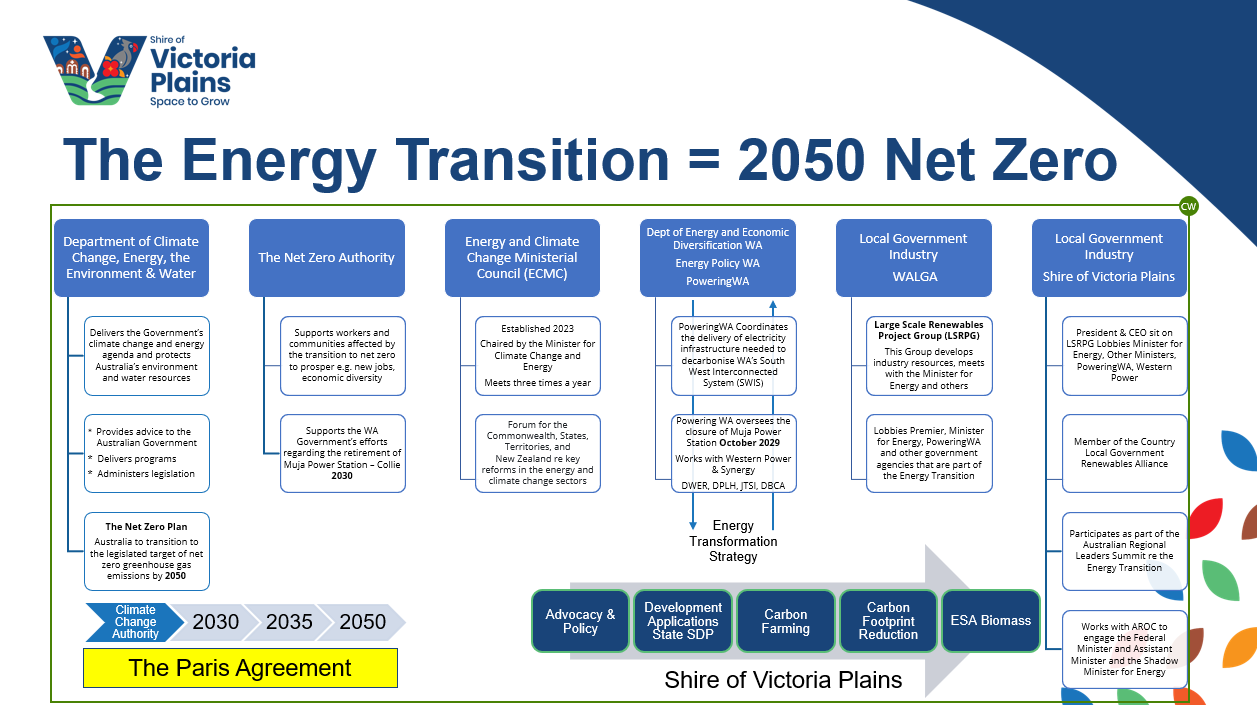
Who is involved? A visual Guide
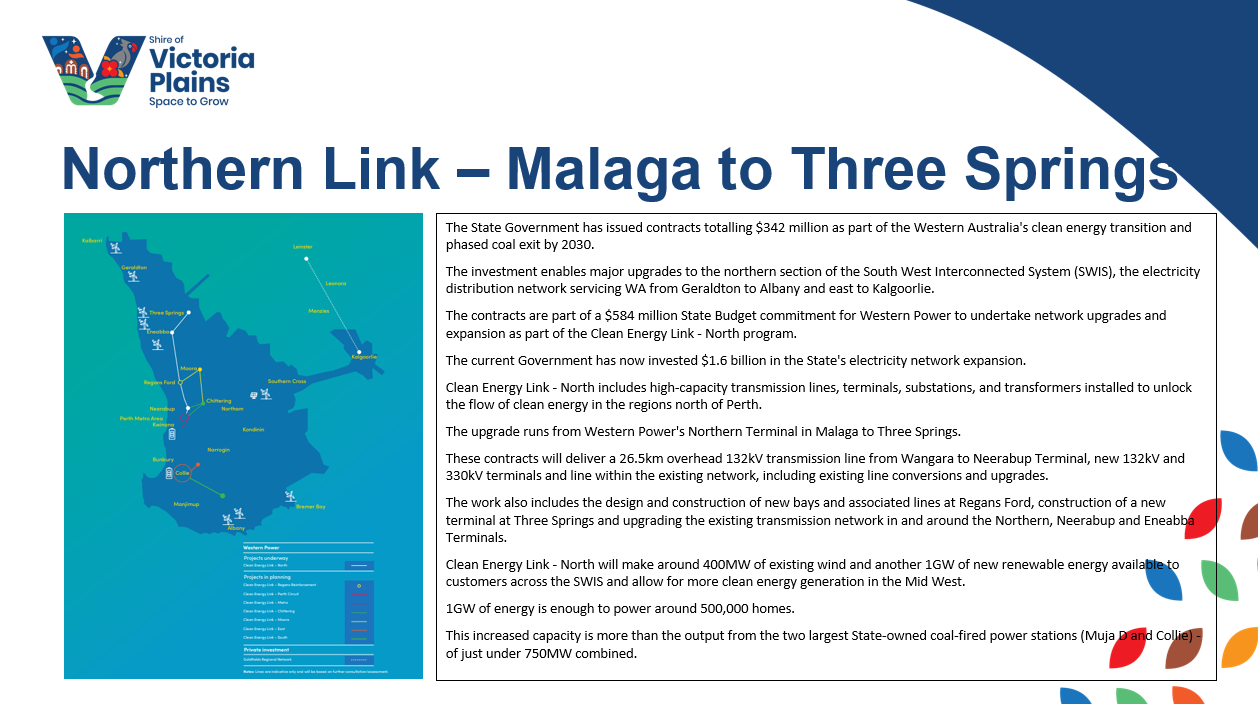
Northern Link